
What is the V/F control
2024-06-28
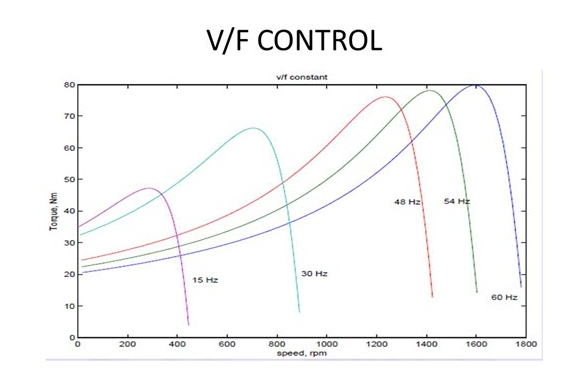
The principle of V/F control is to control the output torque and speed of the motor by adjusting the ratio of input voltage and frequency based on the characteristic curve of the motor. Usually, when the load of the motor increases, it is necessary to increase the ratio of voltage and frequency to maintain the output capacity of the motor. V/F control can ensure that the motor can maintain stable speed and output power under different load conditions.
V/F control has many advantages, including simplicity, low cost, and fast response speed. In addition, V/F control can achieve precise speed control by adjusting the ratio of voltage and frequency to meet the needs of different applications.
The advantages of frequency inverter V/F control include:
1. Easy to operate: V/F control is a relatively simple control method that is easy to understand and operate, suitable for various application scenarios.
2. Good stability: V/F control can maintain the stability of motor operation, effectively reducing motor operating noise and vibration.
3. Energy saving and efficiency: V/F control can dynamically adjust the motor speed according to load requirements, achieving energy-saving and efficient operation, reducing energy consumption and costs.
4. Wide applicability: V/F control is suitable for various types of motors, including induction motors, permanent magnet synchronous motors, etc., with strong universality and applicability.
5. Low maintenance costs: The hardware and software costs of V/F control are relatively low, and the maintenance and repair costs are also relatively low, which can reduce the operating costs of the equipment.
6. High reliability: V/F control has high reliability and stability, which can ensure long-term stable operation of equipment, reduce failure rates and downtime.
1. Easy to operate: V/F control is a relatively simple control method that is easy to understand and operate, suitable for various application scenarios.
2. Good stability: V/F control can maintain the stability of motor operation, effectively reducing motor operating noise and vibration.
3. Energy saving and efficiency: V/F control can dynamically adjust the motor speed according to load requirements, achieving energy-saving and efficient operation, reducing energy consumption and costs.
4. Wide applicability: V/F control is suitable for various types of motors, including induction motors, permanent magnet synchronous motors, etc., with strong universality and applicability.
5. Low maintenance costs: The hardware and software costs of V/F control are relatively low, and the maintenance and repair costs are also relatively low, which can reduce the operating costs of the equipment.
6. High reliability: V/F control has high reliability and stability, which can ensure long-term stable operation of equipment, reduce failure rates and downtime.
Overall, V/F control is a simple and effective motor control technology widely used in various industrial fields. By adjusting the ratio of voltage and frequency, stable speed and output power can be achieved, thereby improving production efficiency and saving energy.
Analyze how the vfd convert frequency
Related Article

There are many parameters to set for the frequency converter, and each parameter has a certain selection range. During use, it is often encountered that the frequency converter cannot work properly due to improper setting of individual parameters. Therefore, it is necessary to set the relevant parameters correctly.
13 commonly used parameters of frequency converters
Since the emergence of automatic induction motors, variable frequency operation has existed in the form of AC generators. Change the speed of the generator and its output frequency. Before the emergence of high-speed transistors, this was one of the main ways to change the motor speed, but the frequency change was limited due to the generator speed reducing the output frequency instead of voltage.
Analyze how the vfd convert frequency